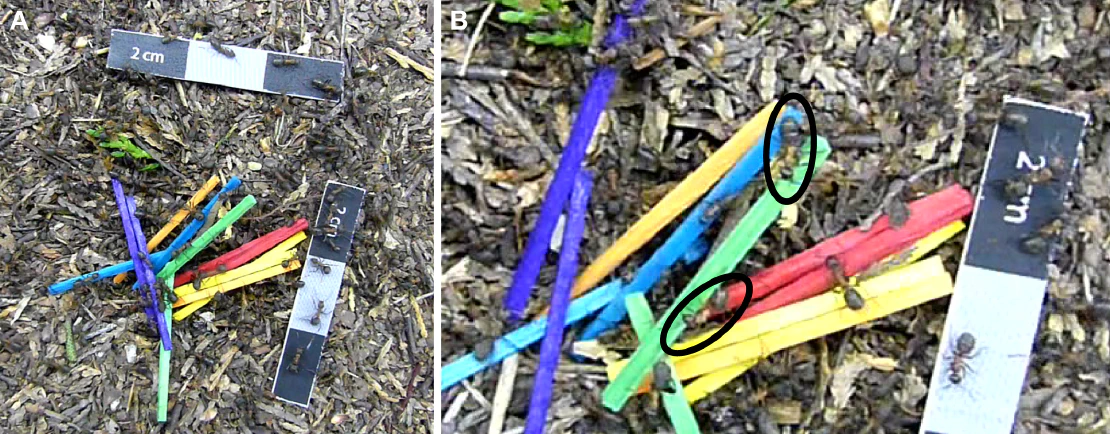
Wood ants maintaining their nests can move sticks cooperatively even when there is no shared destination or leader directing the task. Experiments showed that an ant joining an already moving stick grips it more quickly and aligns itself more precisely than an ant approaching a stationary stick. Ants also remain engaged longer and make fewer grip changes when their efforts successfully reinforce the movement.
The coordination appears to arise from simple sensorimotor rules. Motion, tension, torque and other local mechanical changes in the stick provide feedback that each ant can use to adjust its own behaviour. Imprecise individual actions thereby produce useful group-level transport without explicit signalling or a global plan.
Why it matters: The stick functions as both the shared task and the communication channel. This offers a concrete model for distributed machines or software agents that coordinate through changes in shared work state rather than exchanging detailed messages or relying on central control.