Act I Part 1: The Game with No Player
The adaptive-emergent blog has over 100 posts on swarm and natural intelligence: communication even though some of these describe the most basic microbial life. In many cases we can model this behaviour as algorithms: what appears as intention is in fact mathematics. In this series on cellular automata, we delve deeper into the numbers.
Imagine a game in which nobody plays. There are no pieces to move, no opponent and no objective. Once the starting position is chosen, the game proceeds entirely by itself.
This is Conway’s Game of Life, devised by the British mathematician John Conway and introduced to a wide audience by Martin Gardner in his Scientific American column in October 1970. Despite its name, Life was not intended as a simulation of biology. It is a mathematical system consisting of a grid of cells, each of which is either “alive” or “dead”.
Each cell pays attention only to its eight immediate neighbours. At every step, all cells update simultaneously according to four simple rules:
- a live cell with fewer than two live neighbours dies (underpopulation);
- one with two or three survives;
- one with more than three dies (overpopulation); and
- a dead cell with exactly three live neighbours becomes alive (reproduction).
In the compact notation used for Life-like cellular automata, this is written B3/S23: a dead cell is born with three live neighbours, while a living cell survives with two or three.
That is the entire system. There is no instruction for creating a particular shape, no rule for movement and no central controller with a view of the whole grid. Every cell responds only to its immediate surroundings.
Yet larger structures appear.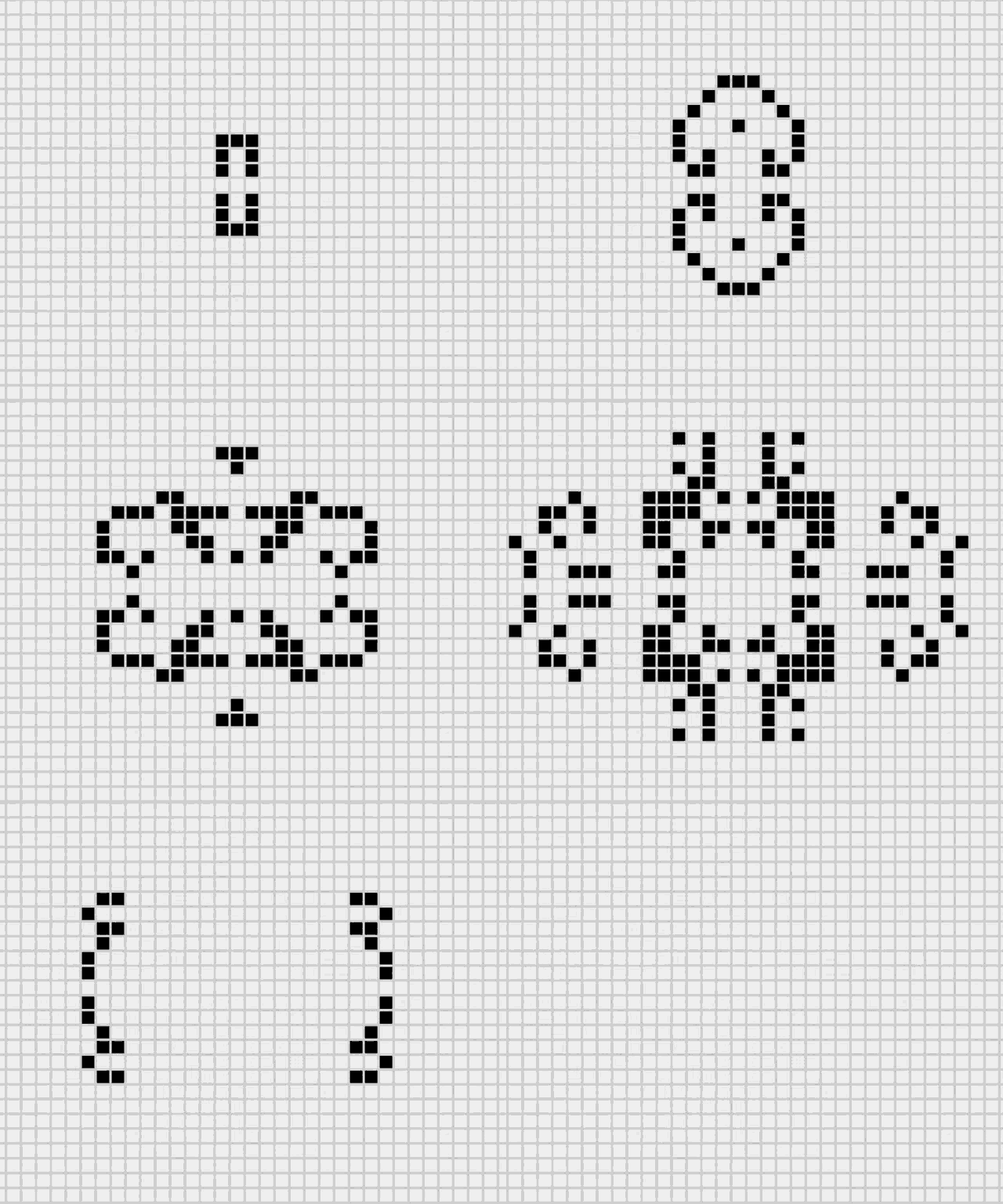
Gliders, Blocks, and Blinkers
In Conway’s world, a block is a 2x2 square of live cells. Each live cell has exactly three live neighbours, so all four survive. No surrounding dead cell has exactly three neighbours, so nothing new is born. The pattern therefore remains unchanged forever. In Life terminology, it is a still life.
A blinker is the simplest oscillator, consisting of three live cells in a line: ■ ■ ■
On the next generation, the two end cells die and two new cells are born above and below the middle one:
■
■
■
One generation later it returns to the horizontal form. So, it alternates forever between those two states. It is a period-2 oscillator: persistence through repeated change.
A glider consists of five live cells. Over four generations it changes shape and then returns to its original configuration one cell diagonally from where it began. As the cycle repeats, the pattern appears to move steadily across the grid.
But none of its individual cells moves anywhere. Some cells die while others become alive, and the larger pattern reappears slightly farther across the grid.
So what exactly is moving? The glider cannot simply be a particular collection of cells, because those cells are continually being replaced. Its identity lies instead in a pattern of relationships maintained through time.
The analogy should not be pushed too far, but the idea has echoes elsewhere. A whirlpool retains a recognisable form while different water molecules pass through it. A flame persists while its constituent gases continually change. Living organisms also preserve organisation despite continual turnover of their physical components.
A glider is not alive, and Game of Life is not a biological model. What it gives us is an unusually clean example of something more general:
Persistent organisation need not reside in persistent components.
Five cells, 1,103 generations
The R-pentomino provides a different kind of surprise. It also begins with only five live cells, packed into a tiny area. Unlike the block or blinker, however, it does not quickly settle into a stable or repeating pattern. Instead, it produces a long cascade of births, deaths, collisions and newly formed structures.
[R-pentomino animation: generation 0 → 1,103]
It takes 1,103 generations before the activity finally settles! By then, those five starting cells have produced a sprawling history that includes stable structures, oscillators and gliders escaping across the grid. Life enthusiasts call such long-lived small patterns methuselahs.
Nothing has been added to the rules. There is no hidden randomness and no external intervention. The same four rules are being applied repeatedly to every cell. The complexity lies in their consequences.
Simple rules, unforeseen behaviour
This is one of the central lessons of cellular automata: simple deterministic rules do not necessarily produce simple behaviour.
Everything that happens in Life follows mechanically from the starting pattern and the same local rules. Yet those rules can produce stable structures, oscillators, moving patterns, collisions and, as researchers later discovered, mechanisms capable of carrying information and performing computation.
This is what made Conway’s game much more than a recreational puzzle. The surprise is not merely that complicated things can happen; the more interesting result is that recognisable organisation appears without being explicitly specified anywhere in the system.
No cell knows that it is part of a glider. No cell knows whether the pattern around it will eventually stabilise, move across the grid or interact with another pattern. Each one responds only to what is immediately nearby.
The larger behaviour belongs to the system; it gives us a very simple setting in which to explore a much larger question:
How can global order arise from local interactions alone?
When Gardner first introduced Conway’s game in Scientific American, the fascination lay partly in discovering what such a tiny set of rules could do. More than half a century later, people are still finding new patterns and exploring the computational world hidden inside them.
But Conway was not the beginning of this story. Decades earlier, John von Neumann had been pursuing an even stranger problem: could a machine build a copy of itself?
His search for an answer led toward a world of cells, neighbourhoods and local rules — the mathematical machinery that would eventually make the Game of Life possible.
In part two we look at: Before Life — Can a Machine Reproduce Itself?