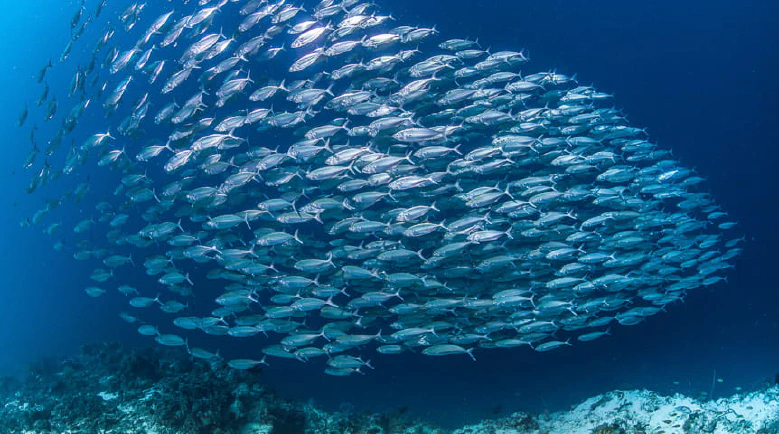
Researchers have developed a way to infer which neighbours an animal is actually responding to directly from collective-movement data.
The method tests combinations of interaction distance and viewing angle, then measures how strongly the average heading of candidate neighbours predicts an individual’s subsequent direction. Applied to golden shiners, it recovered interaction regions consistent with independently measured visual ranges and blind zones. The approach is designed to turn large tracking datasets into explicit local interaction rules rather than treating coordinated movement as an unexplained group-level pattern.