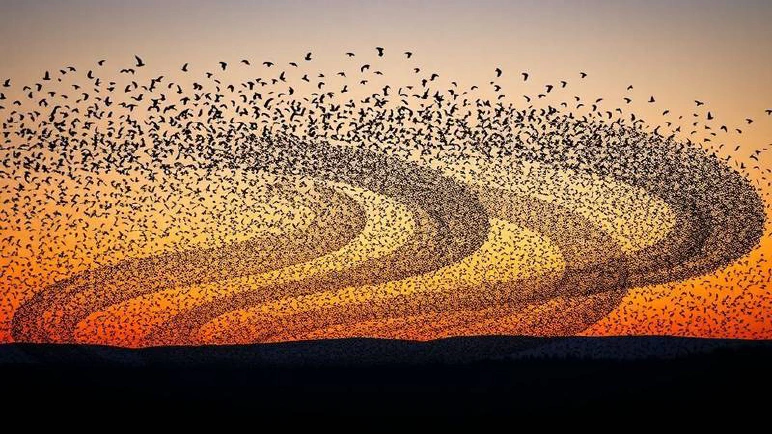
A minimal flocking model shows that a directional change initiated by one agent can propagate across an entire group at approximately constant speed through asymmetric local interactions alone.
The researchers modelled agents whose influence on neighbours need not be reciprocated equally. That nonreciprocity was sufficient to generate wave-like transmission of a turning signal through an ordered flock, without adding an explicit momentum-like or inertial variable to each agent. Continuum analysis traced the propagation directly to the asymmetric interaction structure and produced testable predictions for natural groups.