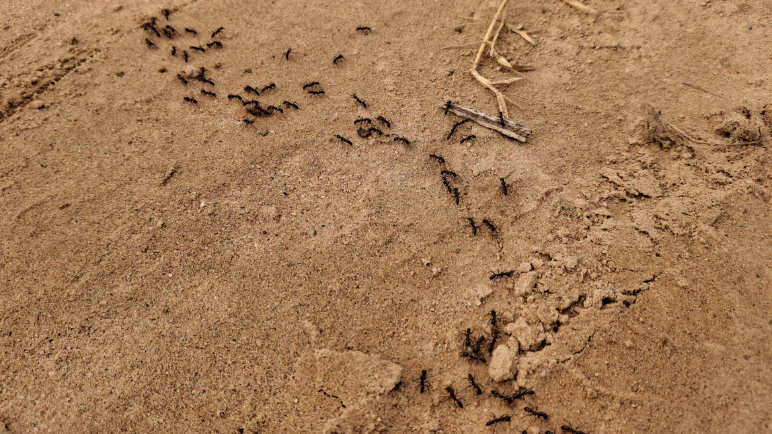
Social insects provide concrete examples of collectives enforcing system-level constraints through local behaviour even when no individual can measure the state of the whole group.
In work presented by Ted Pavlic, army ants form temporary behavioural barriers between neighbouring traffic flows, preventing aggressive encounters; comparable structures can emerge in multi-agent reinforcement learning without explicitly programming wall formation. Other examples examine decentralised regulatory feedback and physically embodied quorum sensing in which a collective detects a group-level threshold that is inaccessible to any individual member.
This sits directly at the biology-to-engineering boundary Adaptive Emergent is interested in. The striking idea is that safety constraints, set-point regulation and threshold detection can be properties of interactions rather than capabilities assigned to a supervisor. It also provides an explicit bridge from observed insect rules to multi-agent learning and engineered distributed sensing.