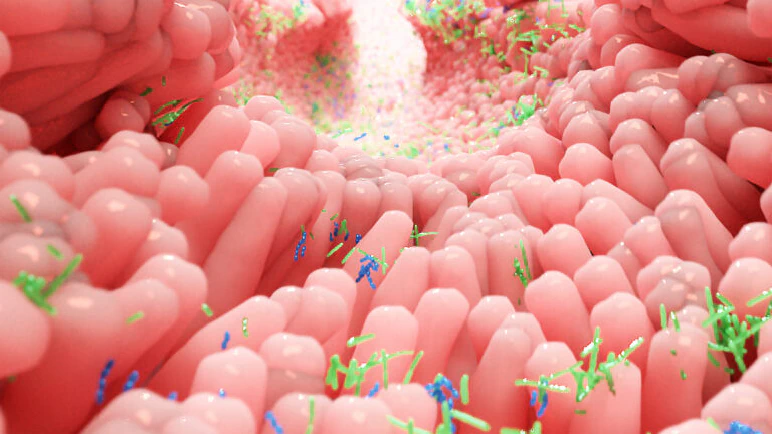
Gut bacteria coordinate through multiple overlapping communication channels rather than relying on a single signalling mechanism.
A new review describes three major pathways: quorum sensing changes gene expression as bacterial population density changes; extracellular vesicles transport proteins, nucleic acids and signalling molecules between cells; and horizontal gene transfer distributes genetic capabilities through microbial communities. These channels support both cooperation and competition and also cross the bacterial-host boundary, allowing microbial populations and host cells to influence one another’s state and behaviour.
The interesting architecture is communication diversity. The same distributed community combines lightweight state signalling, packaged message delivery and actual transfer of executable biological capability. Different channels operate over different timescales and carry different kinds of information, yet collectively shape community stability and adaptation. That is a useful natural analogue for heterogeneous multi-agent systems whose coordination cannot be reduced to one universal message protocol.
https://link.springer.com/article/10.1186/s10020-026-01641-y