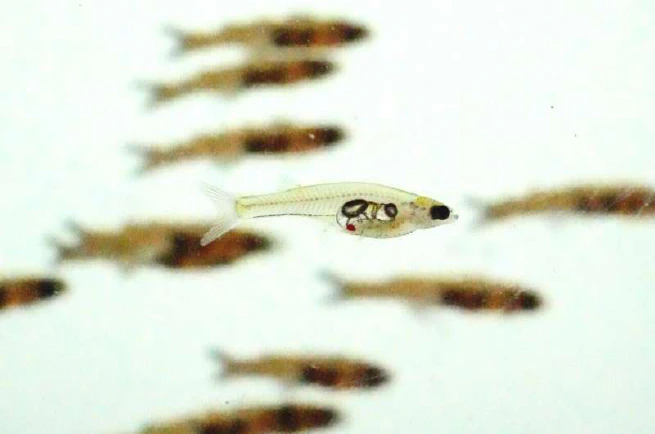
Schooling glassfish can infer danger from the behaviour of nearby fish even when they never see the threat themselves.
This exposes a remarkably economical distributed warning mechanism. An agent does not need to know what another agent sensed, receive an explicit alarm message or even identify the threat. It only needs to recognise a trusted neighbour’s normal behavioural signature and detect a sudden state change. Local observations can therefore propagate information beyond each participant’s sensory range while retaining contextual filtering that reduces reactions to irrelevant motion.
Experiments with Danionella cerebrum found that fish farther from a simulated predator escaped when they saw better-informed neighbours flee. Virtual fish produced the same response, and neural imaging revealed visual circuits especially sensitive to conspecifics that suddenly escaped or disappeared. Crucially, the response depended on species-typical burst-and-glide movement: identical disappearances following artificial smooth motion did not trigger the same behaviour.
https://phys.org/news/2026-09-social-brains-animal-groups-danger.html