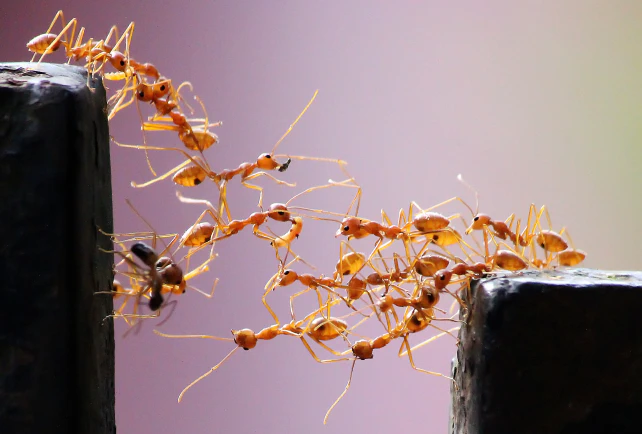
Fire ants demonstrate several distinct ways that useful group-level behaviour can emerge from decentralised interactions.
Research presented by collective-behaviour specialist Takao Sasaki includes workers dynamically self-assembling into pontoon bridges across water, rafts collectively selecting a swimming direction toward visual landmarks, and colonies depositing particles to construct paths across difficult substrates. Remarkably, repeated attempts produce progressively straighter and more efficient paths, providing evidence of collective learning in which improvement belongs to the colony even though no individual ant oversees the solution.
The path-building result is especially interesting: information about previous activity can become embodied in a modified environment, allowing subsequent behaviour to improve without requiring a central memory or planner. It is a concrete example of collective capability accumulating outside any single agent.