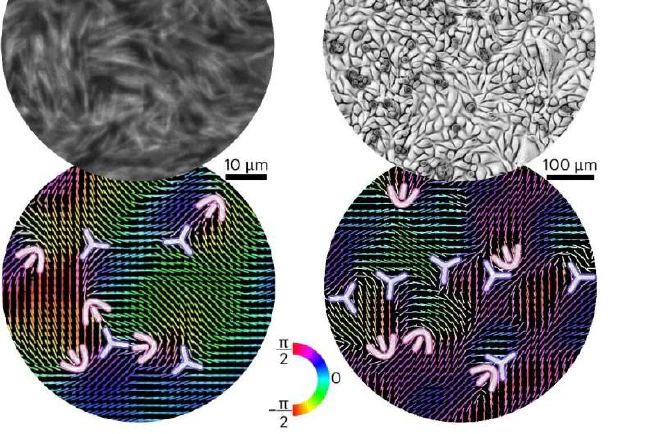
Swarming bacteria and human tissue cells spontaneously create large-scale flow patterns whose dynamics cannot be explained by conventional passive-matter physics.
Researchers studying Bacillus subtilis swarms and human respiratory epithelial cells found that self-propelled cells form active-nematic structures containing topological defects that are created and annihilated through asymmetric, irreversible trajectories. The microscopic ability of each cell to generate its own motion therefore changes the symmetry and dynamics of the collective, producing curved flows and persistent patterns that do not arise in equivalent passive liquid-crystal systems.
https://phys.org/news/2026-09-swarming-bacteria-tissue-cells-defies.html