So far we have met two very different cellular automata. In part 2, John von Neumann designed an elaborate artificial world in which a machine could reproduce itself. Conway later stripped the idea back to cells that were simply alive or dead and asked what a few local rules could produce.
At its simplest, a cellular automaton is a collection of cells arranged in some kind of space. Each cell has a state, and that state changes according to rules based on the states of nearby cells.
That gives us four basic ingredients: cells, states, neighbourhoods and rules.
Cells, states and neighbours
In Conway’s Game of Life, the cells sit on a square grid and have two possible states: alive or dead. But neither choice is fundamental.
A cell might have three states, twenty-nine states or hundreds. It need not represent anything biological. It could stand for a patch of land, a component in a network, a section of traffic flow or simply one location in an abstract mathematical world.
The word cell means the smallest unit in the model.
The next choice is who counts as a neighbour. In Life, a cell is affected by the eight cells immediately surrounding it. This is called the Moore neighbourhood. Another common arrangement uses only the four cells above, below, left and right: the von Neumann neighbourhood.
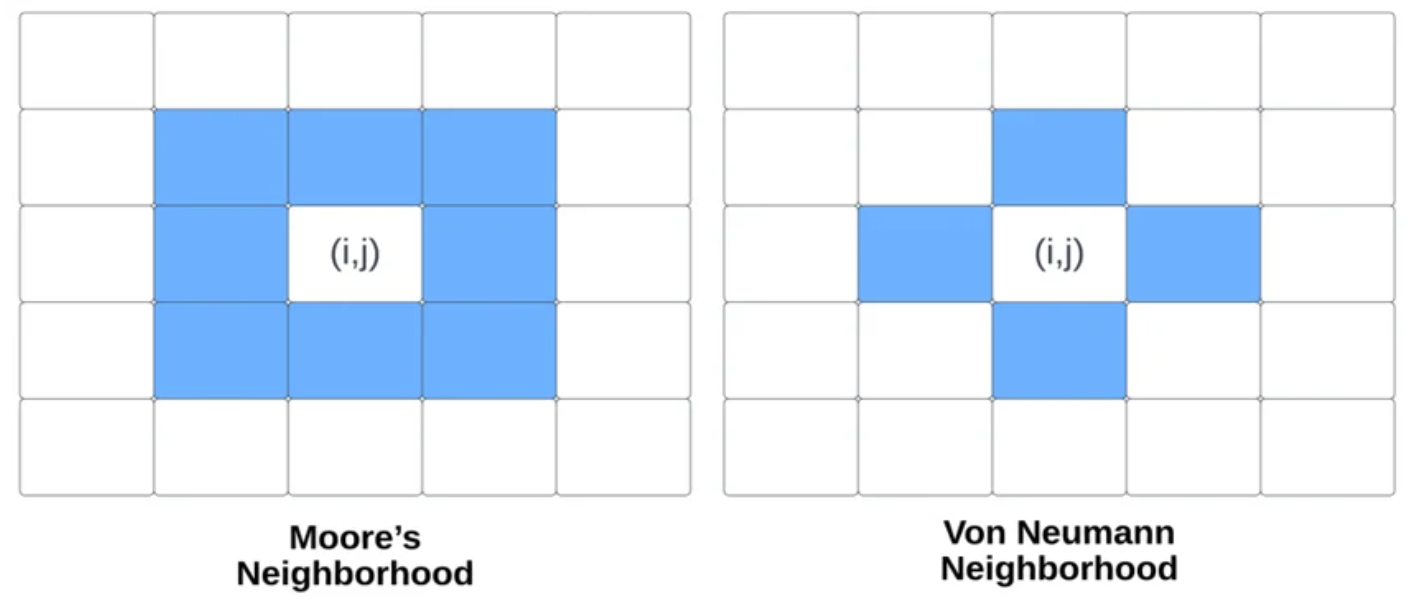
Even this apparently small choice matters. Change who can interact with whom and you change what kinds of patterns can form.
Local rules, global consequences
Once the neighbourhood is defined, each cell applies a transition rule.
In Conway’s Life, the rule is written B3/S23: a dead cell is born with exactly three live neighbours, while a live cell survives with two or three. Once we separate these ingredients, Conway’s Life stops looking like the cellular automaton and becomes one particular world: a square grid, two states, eight neighbours and the rule B3/S23.
Change just one part and the behaviour can change dramatically.
HighLife, for example, uses B36/S23. The only difference is that a dead cell can also be born when it has six live neighbours. That single extra condition allows a small pattern to reproduce copies of itself.
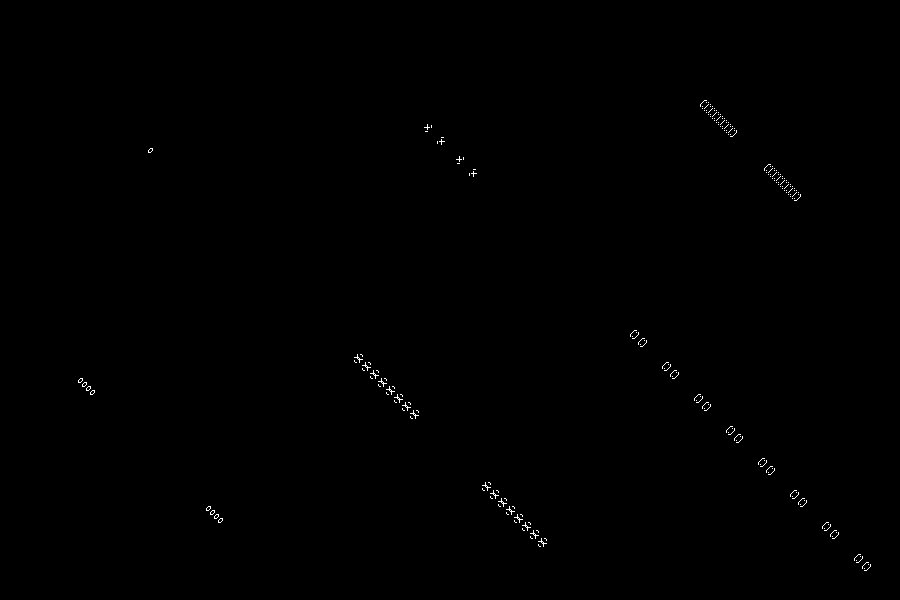
Day & Night uses another rule again and produces dense structures in which live and dead regions play unusually symmetrical roles.
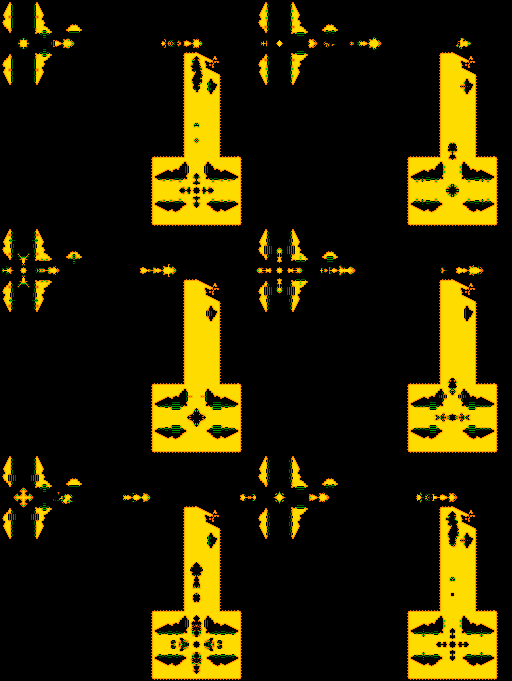
Brian’s Brain goes further by giving each cell three states rather than two. Instead of stable blocks and gliders, it produces travelling waves that look more like bursts of activity passing through a medium.
And in one-dimensional automata, even simpler rules can generate striking structure. Rule 90, starting from a single active cell, produces the triangular pattern known as the Sierpiński triangle.

Simple rules do not give us one kind of world. They give us a space of possible worlds.
From game to tool
This is where cellular automata stop being merely a curiosity associated with Conway.
Programs such as Golly let us explore many different rule systems, but the deeper idea is independent of the software: choose what a cell represents, define what can influence it, specify the local rules, and watch what emerges.
At RedGrid, Mike challenged Simon to model a transformer failure in an electricity network using three rules. Simon did it in two. He used Golly to model failure propagation in the suburb, and then healing as households came to the rescue by reducing their load to allow the blackout to become a brownout and then recover. The simple demo was given to a number of organisations, including Telstra Energy and Telstra IoT, and China Light & Power in Hong Kong. We were onto something when one of the most urbanised places on Earth “got it”; they innately understood the underlying natural rules at play.
The details were different from Life, but the underlying question was the same:
What happens when many simple elements repeatedly respond to their immediate surroundings?
That question closes Act I. We began with Conway’s four rules, went backwards to von Neumann’s self-reproducing machines, and have now reached the broader idea beneath both.
The next act asks what happens when persistent patterns begin to act like things: moving, interacting, carrying information and eventually computing.
Act II: When Patterns Become Things