Researchers have built an active material whose robotic components spontaneously synchronise their movements without instructions from a central controller.
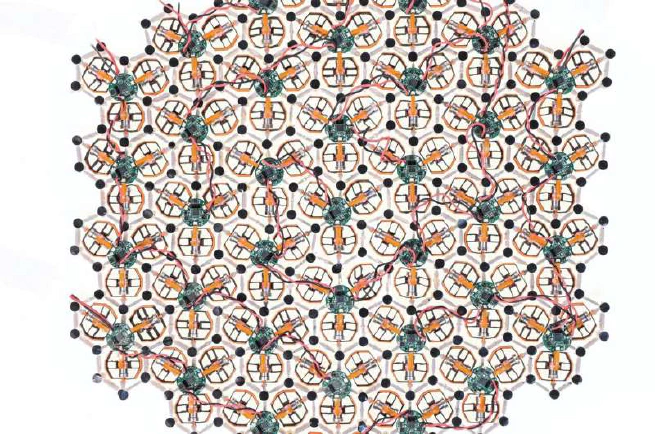
The experimental system consists of interconnected mechanical units containing sensors, actuators and elastic components. By introducing nonreciprocal interactions, where neighbouring components influence one another asymmetrically, researchers produced a phenomenon called wave coarsening. Initially disordered vibrations progressively combine into larger patterns until the entire structure oscillates coherently. Experiments with a 37-unit honeycomb and a 24-unit motorised ring demonstrated collective rhythms that remained stable despite random disturbances.
https://phys.org/news/2026-10-robotic-crystal-rhythm-random-disturbances.html