In the Cellular Automata series, we have completed Act I, which was about The Rules of the World. In Act II, we will look at What the Rules Can Become. Sometimes the thing that moves is the pattern, not its parts.

A block in Conway’s Game of Life never changes. A blinker changes constantly but always returns to the same two states. A glider goes further: it repeatedly reconstructs itself one cell farther across the grid. None of these patterns is specified anywhere in the rules. They exist only because particular arrangements of cells keep recreating the conditions that allow the larger pattern to persist.
This is where cellular automata begin to tempt us into talking about things.
A strange little zoology
Life enthusiasts have accumulated a vocabulary that sounds almost biological. There are still lifes, which remain unchanged; oscillators, which cycle through repeating states; and spaceships, which return to the same form after shifting position.
The glider is the simplest spaceship. More elaborate patterns include guns, which repeatedly emit spaceships; puffers, which move while leaving debris behind; and breeders, which generate patterns that themselves generate further patterns.
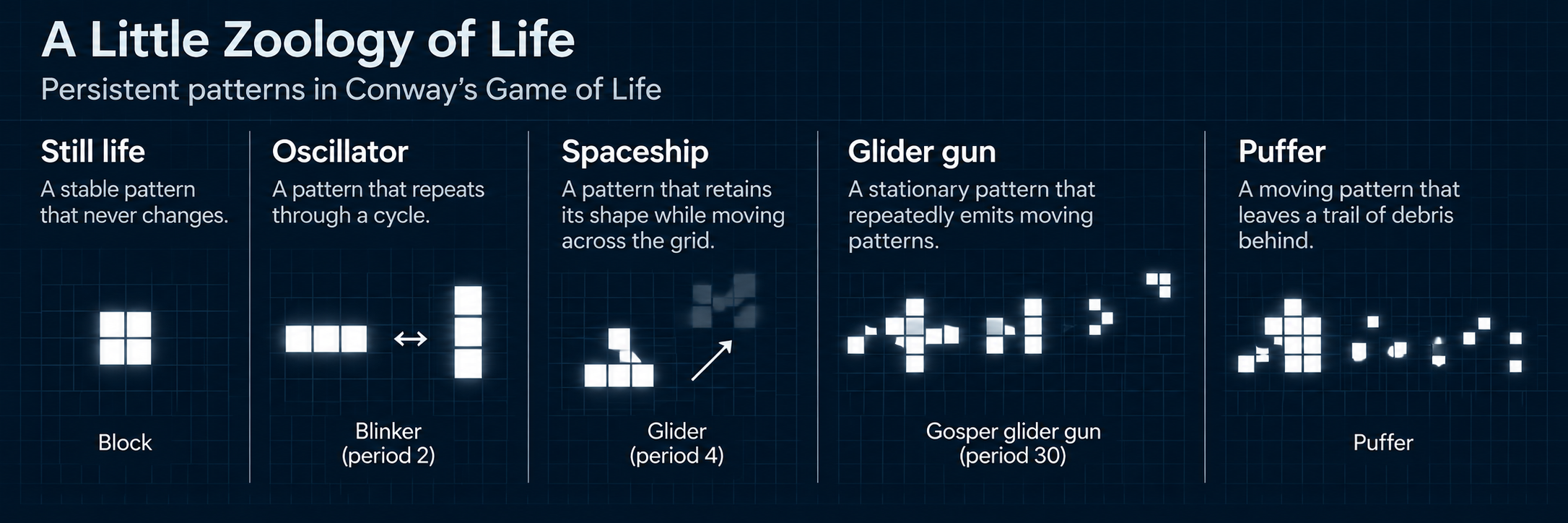
The terminology is playful, but it points to something serious. We are no longer merely describing individual cells. We are recognising persistent structures at a higher level. A glider seems to have an identity even though none of its cells travels with it.
So where does that identity reside? Not in particular cells, but in a recurring organisation of relationships through time.
When interaction starts to matter
Once persistent patterns can move, they can also collide. Two gliders may destroy each other, change direction, create debris or produce another stable pattern. The outcome depends on timing and geometry.
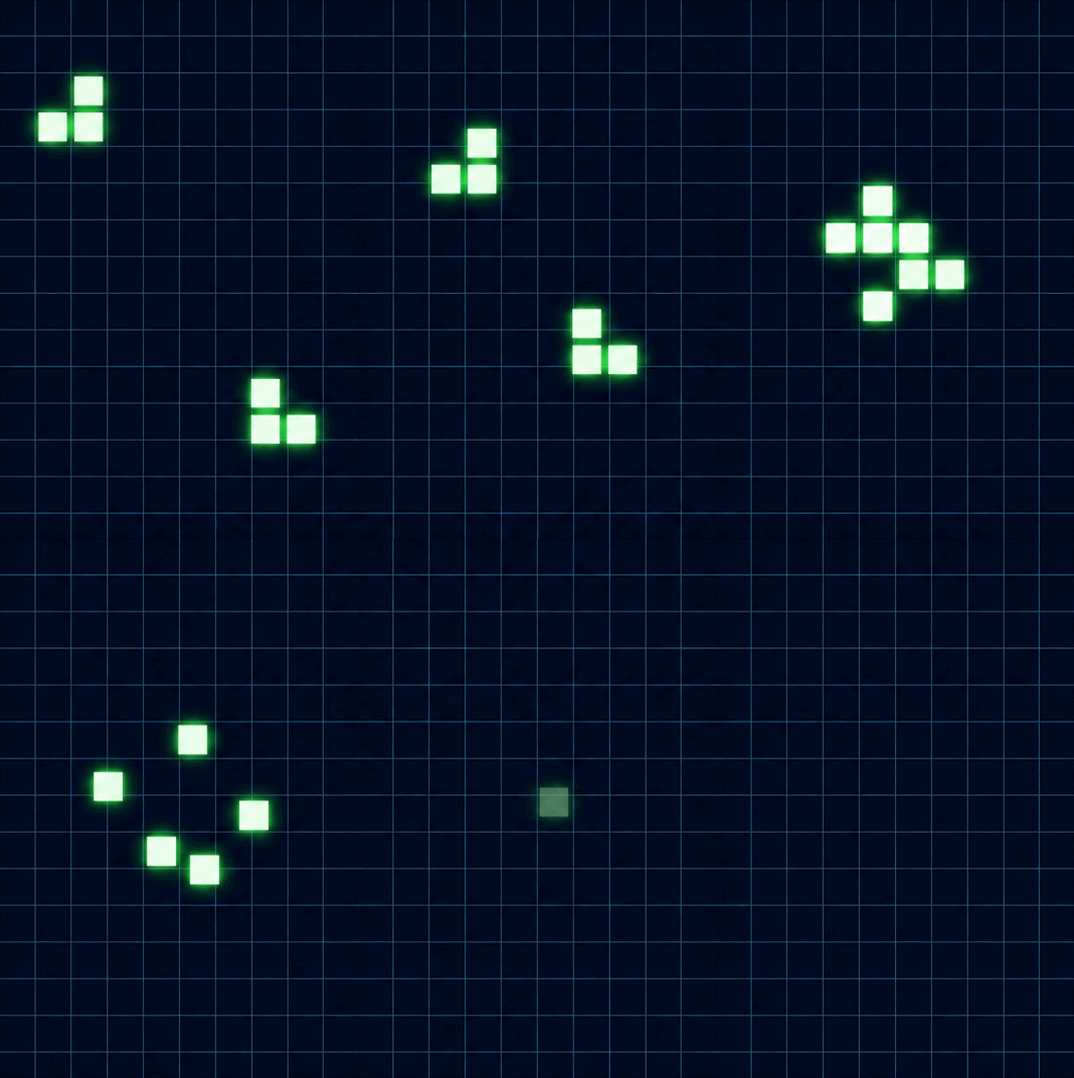
At that point, a moving pattern can be treated as more than an object. It can become a signal.
A glider arriving at a particular place and time can represent one value; its absence can represent another. Collisions can be arranged so that the presence or absence of incoming gliders determines whether an outgoing glider is produced.
This is the beginning of logic.
The cells still know nothing beyond their neighbours. Yet at a higher level, patterns can carry information, interact conditionally and influence distant parts of the system.
From signal to computation
This is not merely a metaphor. Conway’s Life can implement logical operations and memory, and it is capable of universal computation: in principle, a sufficiently large Life pattern can perform any computation that an ordinary general-purpose computer can perform.
Other cellular automata reach the same destination by very different routes. Rule 110, a one-dimensional automaton with an extremely simple local rule, is also computationally universal.

[See Elementary Cellular Automaton to draw other rules and how these fit into Turing machines.]
This is a remarkable jump. A collection of cells following local update rules has become a medium in which information can be transmitted and transformed. But we should be careful about what follows from that.
Computation is not the same thing as intelligence. A glider is not trying to deliver a message, and a logical gate in Life does not understand the operation it performs. Information exists here because of how we choose to interpret and organise the patterns.
When does a pattern become a thing?
Cellular automata make this question unusually visible because the substrate is so simple.
At the lowest level there are only cells changing state. At another level we see gliders, guns and oscillators. At another we can see signals, gates and machines. All of these descriptions can be valid at the same time.
The interesting shift is not that the cells acquire new rules. They do not. What changes is the level at which useful regularities appear. That is one of the central ideas of emergence: a higher-level pattern can have properties that are meaningful and predictable even though those properties are not assigned to any individual component.
The next question is how far this can go. Some rule systems freeze almost immediately. Others dissolve into apparent noise. Between them lie systems capable of long-lived structures, interactions and computation.
Why do some simple rules create such rich worlds while others create almost nothing at all?
In part 5 we will look at the Rules at the Edge: Order, Chaos, and Distributed Intelligence.