Swarm robots that “bloom” could enable adaptive building skins

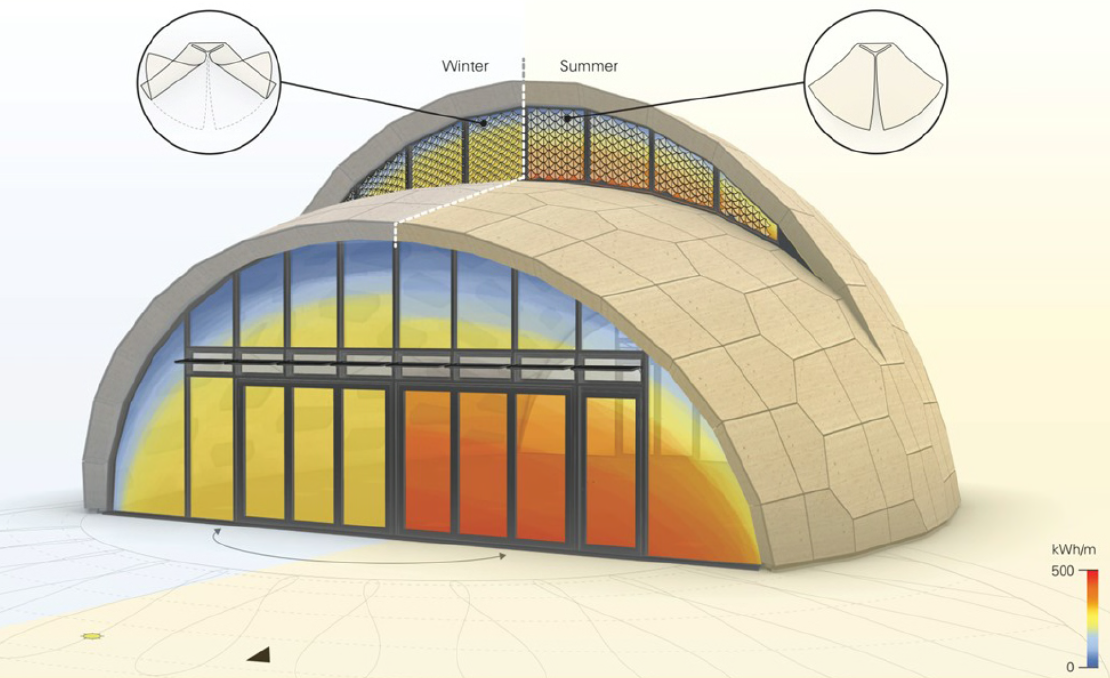
Researchers built modular “SGbots” that communicate locally and collectively adjust their shape—blooming or retracting—to regulate sunlight in real-world window tests.
Read more
Researchers built modular “SGbots” that communicate locally and collectively adjust their shape—blooming or retracting—to regulate sunlight in real-world window tests.
Read more
Researchers at Tufts University have developed a biomimetic coating that changes color when struck, revealing both the location and approximate strength of an impact without needing embedded electronics.
Read more
Sparxell is on a mission to revolutionise the world of industrial colourants. Its patented technology uses cellulose from wood pulp to create structural colour – the same principle that creates iridescent butterfly wings – eliminating petroleum-based chemicals, titanium dioxide and toxic heavy metals and minerals.
Read more
This moth-wing-inspired acoustic technology is a strong near-term applicability story because the biological idea is being turned into ultra-thin sound absorption for real interior environments.
Read more
In the future, tiny flying robots could be deployed to aid in the search for survivors trapped beneath the rubble after a devastating earthquake.
Read more
Grasshoppers may not spring to mind as paragons of graceful flight. But for a team of Princeton engineers, these gangly insects have inspired a new approach to robotic wings.
Read more
Bees navigate their surroundings with astonishing precision. Their brains are now inspiring the design of tiny, low-power chips that could one day guide miniature robots and sensors.
Read more
Researchers at Japan’s National Institute of Informatics and collaborators built an insect-inspired robot that can keep tracking an odor source even when one of its two odor sensors fails, by copying the adaptive behavior of silkmoths, which can still navigate with only one antenna.
Read more
Leaving breadcrumbs (well, pheronome trails) to lead the way. https://pmc.ncbi.nlm.nih.gov/articles/PMC10956014/
Read more
This article reports on a robot system inspired by how ants communicate using pheromone trails. Instead of real chemicals, the robots follow artificial “pheromone” signals so they can coordinate with one another and make group decisions in a similar way to ants.
Read more